)
New York Scissor Lift Accident Lawyer
In New York, many industries may require an employee to be moved into a higher position by a scissor lift. Scissor lifts raise workers vertically and bring them back down carefully. These machines get their name from the scissor-like motion the beams make while in motion.
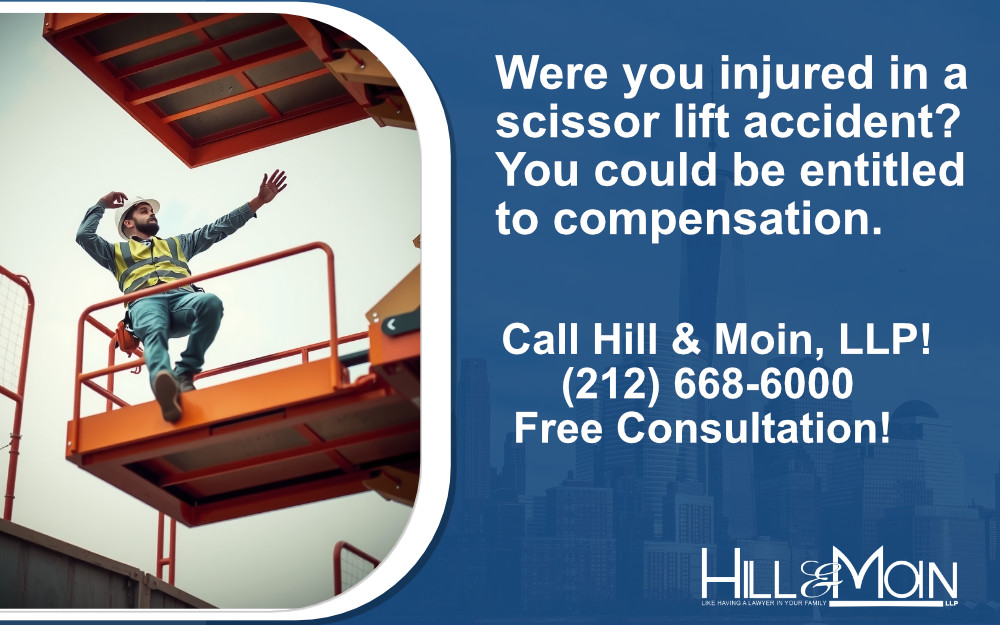
If you were injured in a scissor lift accident, call Hill & Moin today. We understand you are worried about how you will be able to take care of yourself and your family during this difficult time. You need a team of experienced attorneys at your side, so choose us. We have devoted over 40 years of our lives to helping our clients get the legal representation they deserve.
Call Hill & Moin today at (212) 668-6000 for a free case evaluation. There is no fee unless you win.
Scissor Lift and Construction Fall Statistics
Falls remain one of the most serious hazards for construction workers who work at elevated heights, including those using scissor lifts and other aerial platforms. In 2024, 50 construction workers died from workplace injuries in New York, and 24 of those deaths resulted from falls, slips, and trips, according to the U.S. Bureau of Labor Statistics.
Nationwide, the construction industry recorded 1,034 fatal workplace injuries in 2024. Falls, slips, and trips accounted for 389 deaths—more than one-third of all construction fatalities. Nearly 96 percent of those incidents involved falls to a lower level.
Scissor lifts can expose workers to these elevation hazards when equipment is improperly positioned, unstable, defective, or used without adequate safety precautions. Proper training, fall protection, equipment maintenance, and safe positioning are critical to reducing the risk of serious or fatal accidents.
Scissor Lift OSHA Warning
In 2016, OSHA released a publication called “Hazard Alert: Working Safely with Scissor Lifts.” In this guide, it was revealed that the agency investigated 30 accidents in 1 year which all proved to be completely preventable. Nevertheless, 20 led to injuries and 10 were fatal. Each of these incidents sadly resulted from employers who did not address three important safety components.
The three common areas neglected by employers included:
- Fall protection
- Stabilization
- Positioning
Proper Safety Steps All Employers Must Take
It is the responsibility of employers to ensure they take safety seriously. This includes using scissor lifts that are used to lift an employee to a high position within a building. Failing to do so can dramatically increase the risk of injuries or even death.
The steps employers should take to ensure the safe use of a scissor lift include:
- Training workers on how to use the scissor lift
- Setting safety procedures and practices for employees
- Putting fall protection features in place for each scissor lift
- Making sure each scissor lift is ready for use
- Maintaining and repairing scissor lifts
- Giving workers adequate personal protection
- Providing stable and safe locations to use the lift
- Ensuring workers follow all instructions given by the lift’s manufacturer
Common Scissor Lift Accident Causes
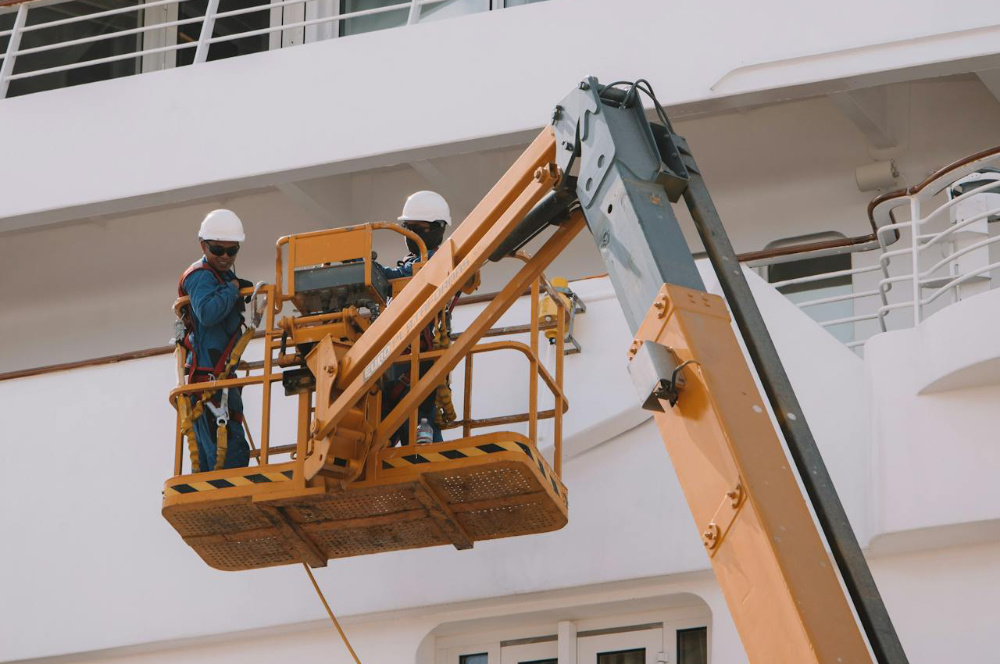
While falls are the main threat that causes the most worker injuries and death, there are other common causes. Lifts are mobile and force a worker into a limited workspace. Below are several of the most common causes of New York scissor lift accidents.
Defective equipment
A worker can be injured or killed by a defective scissor lift. The computer system can malfunction, and wires can fray. This can lead to an unsecured machine that puts others at risk. Employers can avoid these issues with regular checking and proper maintenance when issues come up. Even then, you never know when a piece of equipment will decide to stop working.
Misuse of the machine
Scissor lift operators who do not know what they are doing can cause a whole host of problems. It is not uncommon for workers to be trapped or crushed against objects like walls, trees, or bridges. Everyone who uses a scissor lift should be OSHA certified to prevent anyone from getting hurt. Regular misuse of the machine can also cause it to malfunction and become defective.
Machine tipping over
One threat to scissor lift users is a tip-over. These vehicles are quite narrow and can be overloaded or improperly balanced. This is especially common since these machines are used outside in a variety of weather conditions and on unstable ground. It is important to always check with the lift’s manual to ensure it is used properly, both indoors and out.
Falling off the lift
Workers who fall off the scissor lift experience the most fatalities and serious injuries. These terrifying accidents happen when operators are careless, negligent, or perhaps failing to use proper restraints. It is recommended by OSHA that anyone who operates a scissor lift must use a safety harness. Workers should also keep from reaching beyond the guardrails of the machine and risk falling out.
Not following operational guidelines
There are several operational guidelines scissor lift operators in New York need to follow for safe use. The first is the manufacturer’s manual so workers know how to work the machine. The second is the employer’s safety guidelines so workers know how to properly use the machine in the context of their jobs. Paired with training and certification of workers, the workspace can be safe and accident-free. Failing to follow the guidelines can lead to misuse of the lift.
Being trapped on the lift
Workers who do not know how to properly operate the scissor lift can result in the user being trapped or pinned against objects. It is important to ensure all potential hazards are recognized before using. An operator can be trapped against bridges, trees, walls, and other objects, causing injuries and even death.
Unstable ground
One of the first tasks a scissor lift operator should do is to survey the ground where the lift will be placed. Stable ground is essential to the process if workers want to stay safe. This is important for all outside work. Construction sites are notorious for unstable, muddy ground that can put a scissor lift operator at risk.
Electrical wires
Electrical wires, including power lines, can be a serious threat to scissor lift workers. The metal box can meet an exposed wire and cause electrocution. It is recommended that anyone who needs to operate a lift near power lines receives extra training.
New York scissor lift accidents can happen at any site. If a company’s negligence led to you being injured while working on any aerial platform, call Hill & Moin today.
Who Can Be Liable After a Scissor Lift Accident in New York?
A scissor lift accident may involve several potentially responsible parties. Determining liability requires examining who controlled the worksite, provided the equipment, supervised the work, and was responsible for maintaining safe working conditions.
Potentially responsible parties may include:
- Property owners responsible for safety conditions at the construction site
- General contractors responsible for supervising or controlling worksite safety
- Subcontractors whose actions or unsafe practices contributed to the accident
- Scissor lift manufacturers when defective design or manufacturing contributed to the injury
- Equipment rental companies that supplied defective or unsafe equipment
- Maintenance and repair companies that failed to properly inspect, service, or repair the lift
- Other third parties whose negligence contributed to the accident
New York Labor Law and Scissor Lift Accidents
Scissor lift accidents involving elevation-related hazards may also implicate New York Labor Law §240(1). Commonly known as the Scaffold Law, this law provides protections to certain construction workers exposed to elevation risks and requires appropriate safety devices for qualifying work.
Depending on the circumstances, Labor Law §§200 and 241(6) may also apply. These laws address workplace safety and compliance with specific construction safety requirements. Whether a particular Labor Law applies depends on the work being performed, the cause of the accident, and the parties involved.
Workers’ Compensation and Third-Party Claims
An employee injured while using a scissor lift may qualify for workers’ compensation benefits regardless of who caused the accident. In some cases, the worker may also have a separate third-party personal injury claim against a property owner, general contractor, equipment manufacturer, or another responsible party.
A third-party claim can be particularly important because it may allow recovery for damages that workers’ compensation does not provide, including pain and suffering and other losses resulting from the accident.
What to Do After a New York Scissor Lift Accident?
After you have been injured in a scissor lift accident, you may be confused and worried about your future. Your medical bills are piling up and you have missed plenty of time at work. You may decide you want to sue for compensation.
What are a few things you can do to help the process? This list below may be helpful.
Get medical attention
To win a personal injury case, you need to have evidence that you were injured in a scissor lift accident. Without a record of injuries, compensation may be difficult to attain. Even if you feel fine at the moment, go see your doctor anyway to get checked out. Adrenaline has a way of masking some injury symptoms, so your condition may be worse than you think.
Follow your doctor’s orders
Along with having a record of injuries, you must also follow any treatment plan your doctor has for you. It is not uncommon for the insurance company to assert that a worker made his own injuries worse by failing to seek treatment or follow a doctor’s recommendation. They want to avoid responsibility for your current condition. If you caused your own pain and suffering, they may not be liable.
Frequently Asked Questions – New York Scissor Lift Accident Lawyers
What causes most scissor lift accidents?
Scissor lift accidents are often caused by tip-overs, equipment malfunctions, falls from the platform, improper setup on uneven ground, overloading, contact with overhead power lines, inadequate fall protection, or insufficient operator training.
Can I file a lawsuit after a scissor lift accident in New York?
Yes. While workers’ compensation may cover your workplace injury, you may also have a third-party personal injury claim if someone other than your employer contributed to the accident. Potentially liable parties may include property owners, general contractors, subcontractors, equipment manufacturers, rental companies, or maintenance providers.
Does New York Labor Law apply to scissor lift accidents?
It can. Depending on how the accident occurred, claims involving scissor lifts may fall under New York Labor Law §§ 200, 240, or 241. Whether these laws apply depends on the specific facts of the accident and the work being performed.
What injuries are common in scissor lift accidents?
Scissor lift accidents frequently result in traumatic brain injuries, spinal cord injuries, fractures, crush injuries, amputations, electrocution injuries, internal injuries, and other serious or catastrophic harm.
What compensation can I recover after a scissor lift accident?
If you have a valid third-party personal injury claim, you may be able to recover compensation for medical expenses, lost wages, future medical treatment, reduced earning capacity, pain and suffering, rehabilitation costs, and permanent disability. Workers’ compensation benefits may also be available if the accident occurred on the job.
What evidence is important in a scissor lift accident case?
Important evidence may include accident reports, OSHA investigation findings, maintenance and inspection records, equipment manuals, photographs, surveillance footage, witness statements, training records, and expert evaluations of the scissor lift involved.
How long do I have to file a scissor lift accident lawsuit in New York?
The deadline depends on the type of claim and the parties involved. Claims against public entities often require a Notice of Claim within a much shorter timeframe, so it is important to consult an attorney promptly after the accident.
How much does it cost to hire Hill & Moin LLP?
Hill & Moin LLP handles scissor lift accident cases on a contingency fee basis. You pay no attorney’s fees unless we recover compensation on your behalf.
Call Hill & Moin right away
Before a lawsuit is presented in court, it may be best to negotiate a settlement with the insurance company. Hill & Moin has been handling a wide range of New York construction accidents for over 40 years. Our clients trust us when it comes to negotiating settlements and fighting on their behalf.
Call Hill & Moin today at (212) 668-6000 for a free consultation to learn about the Personal Injury Recovery SolutionsⓇ designed to meet your needs. There is no fee unless you win.
Don’t wonder about your rights!